Ring Overview
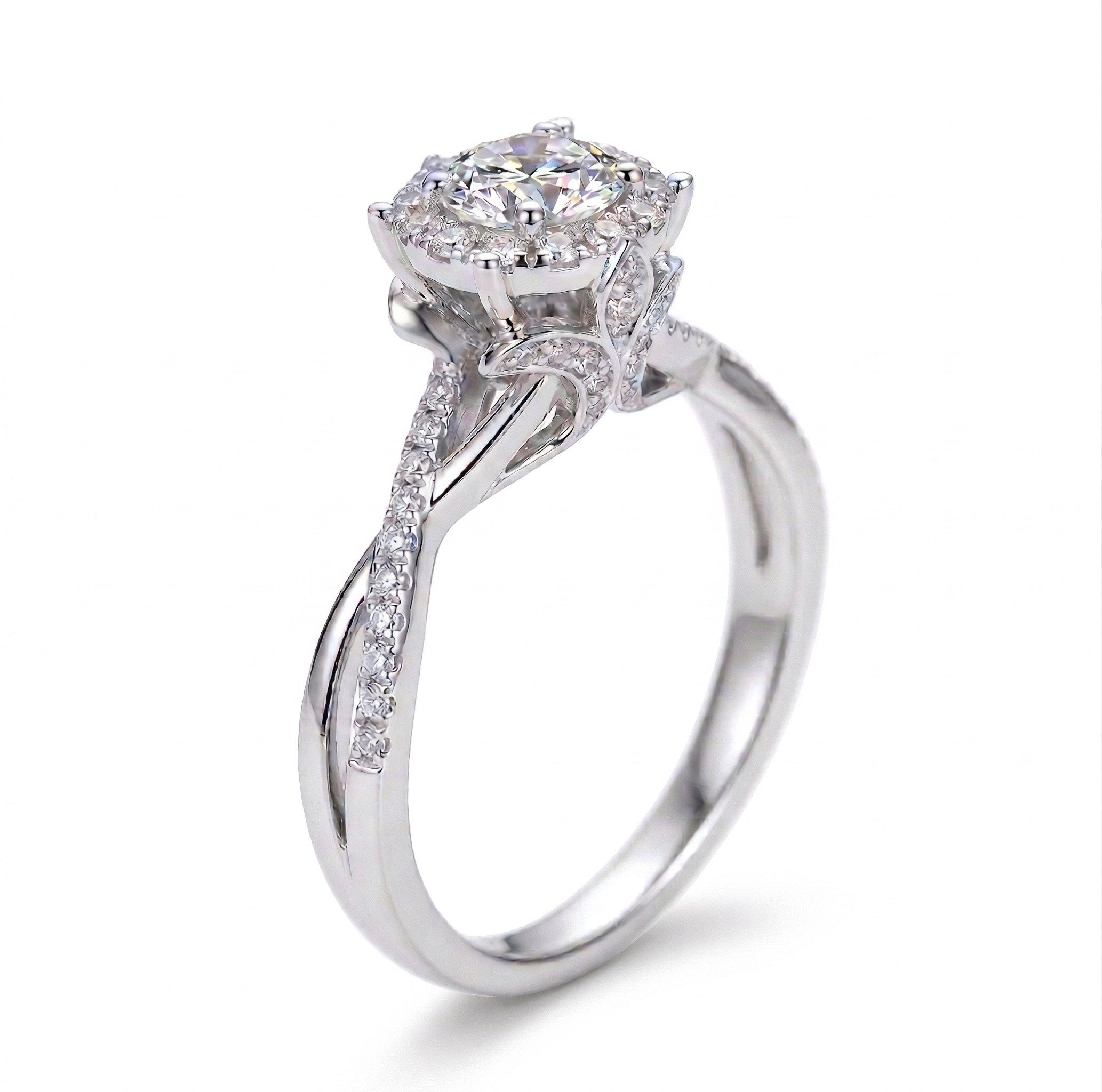
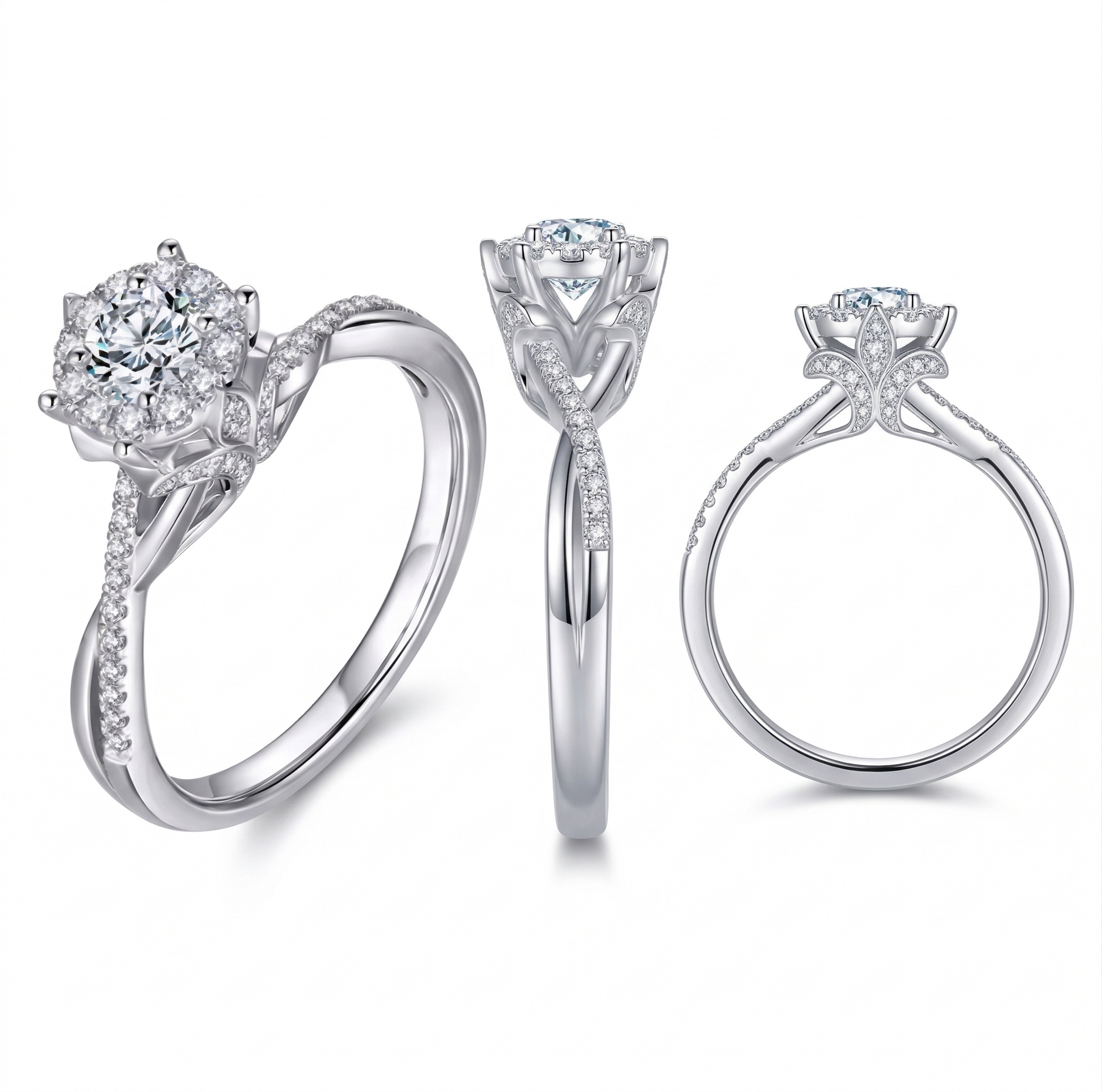
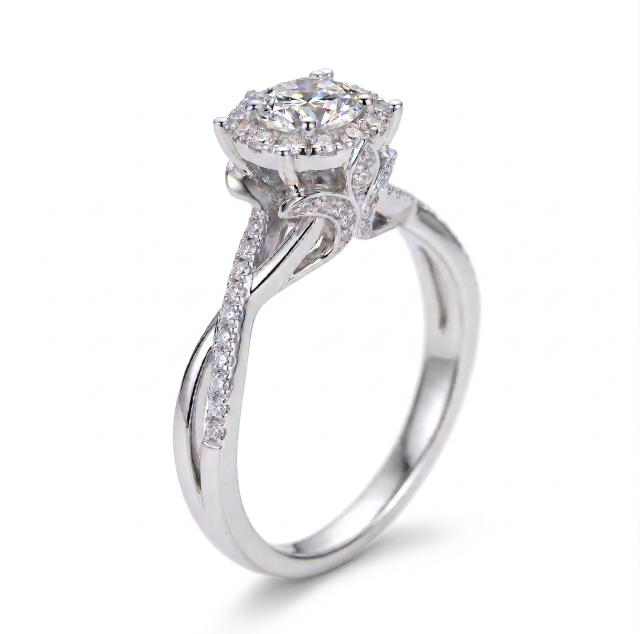
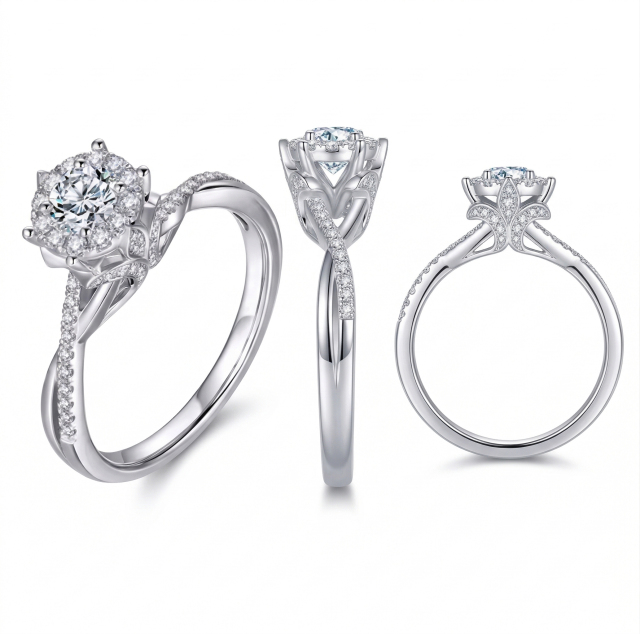
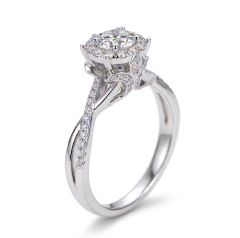
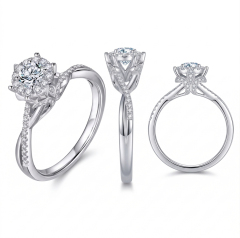
- An 18K gold lab diamond ring built around one 0.6-carat round brilliant stone, supplied with an IGI report issued for that diamond.
- It is made for bridal jewellery businesses and custom studios building a lab-grown offer, and for couples who want the centre stone documented rather than described across a counter.
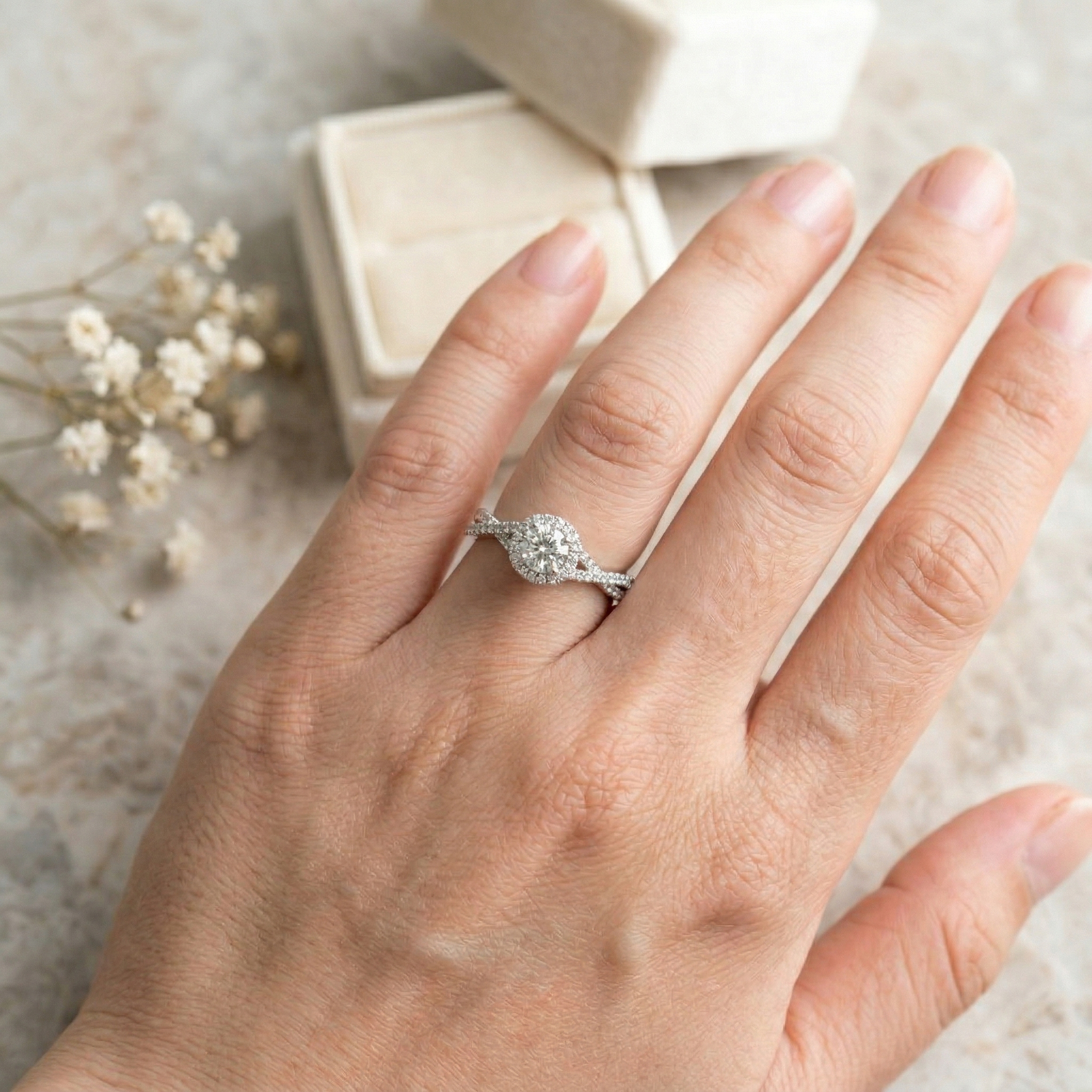
- A 0.6ct lab grown diamond ring at this level of setting reads as fine jewelry rather than a statement piece, which is often exactly what a first lab-grown bridal order needs.
- Nothing is held in stock: every custom lab diamond engagement ring is made against a confirmed order, so the first conversation is about specification rather than inventory.
Petal Basket and Twisted Shank
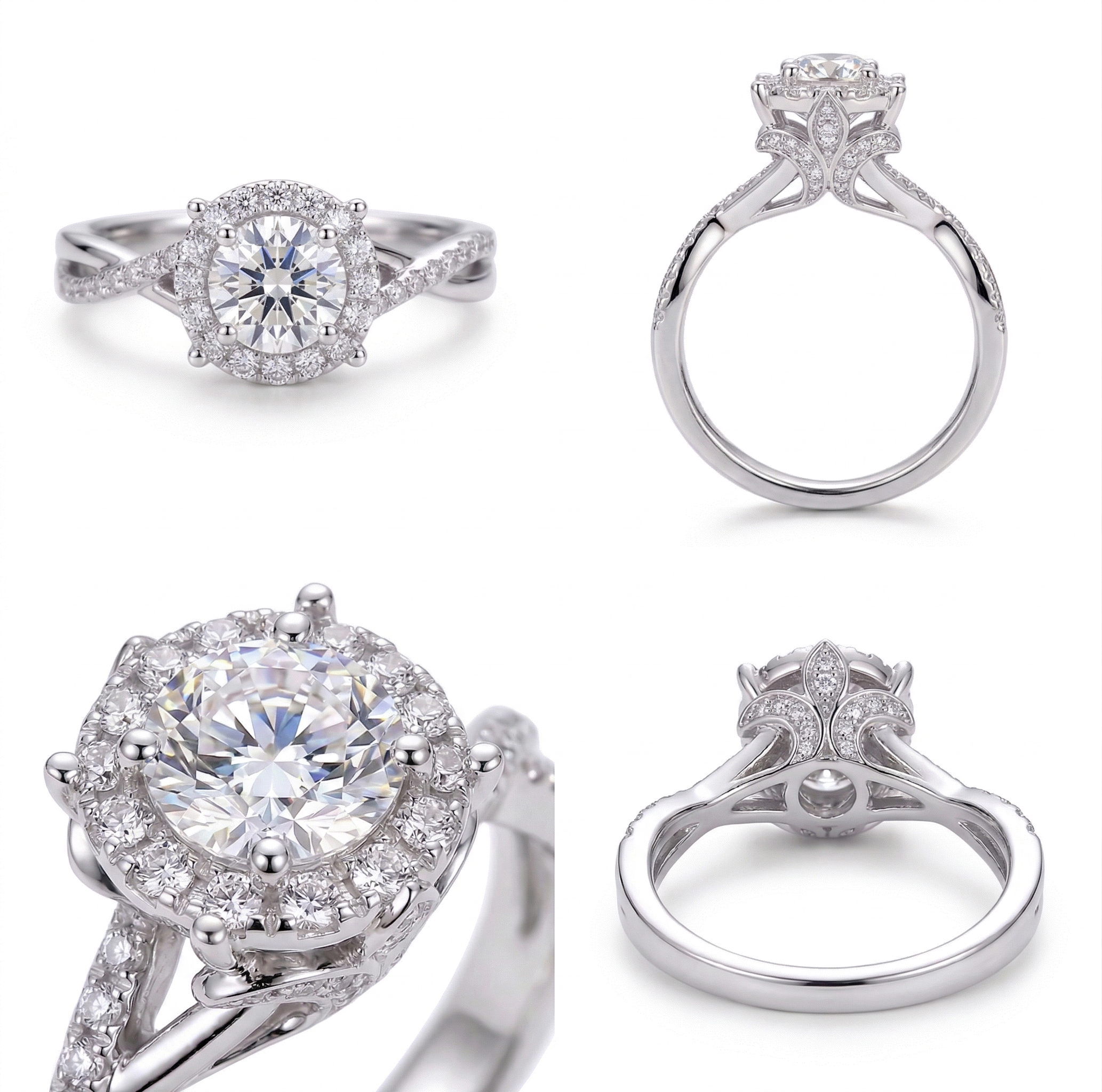
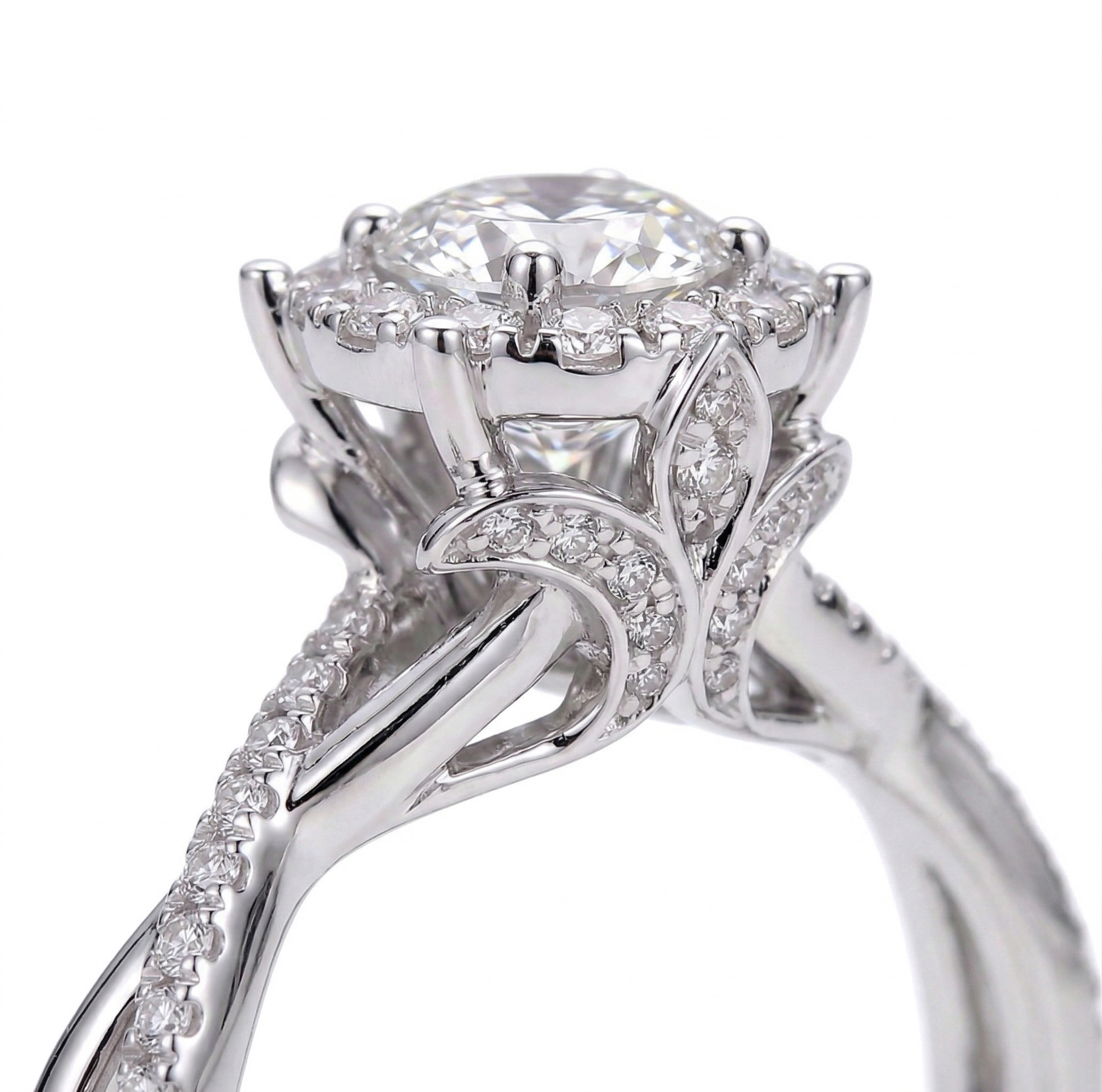
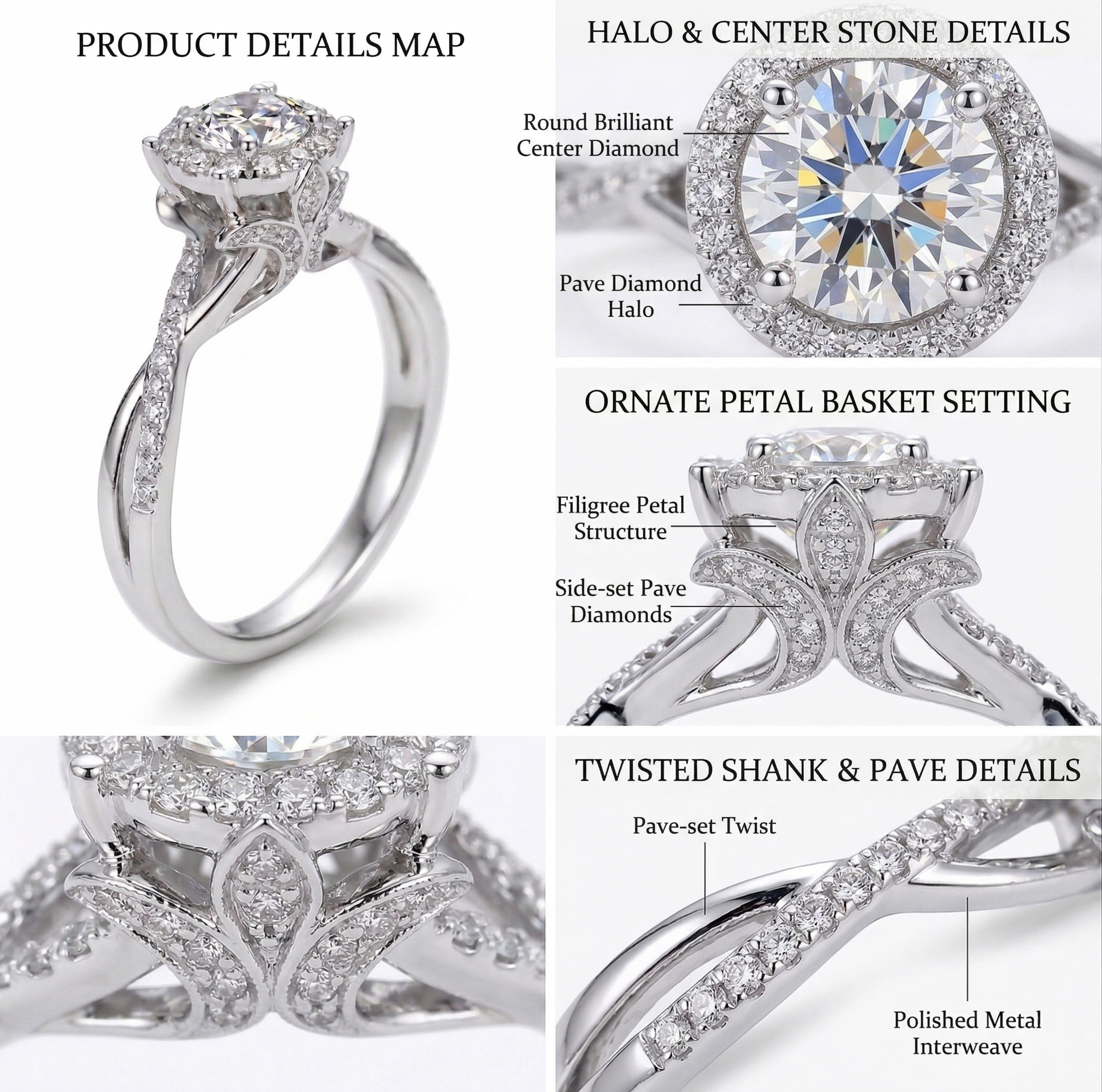
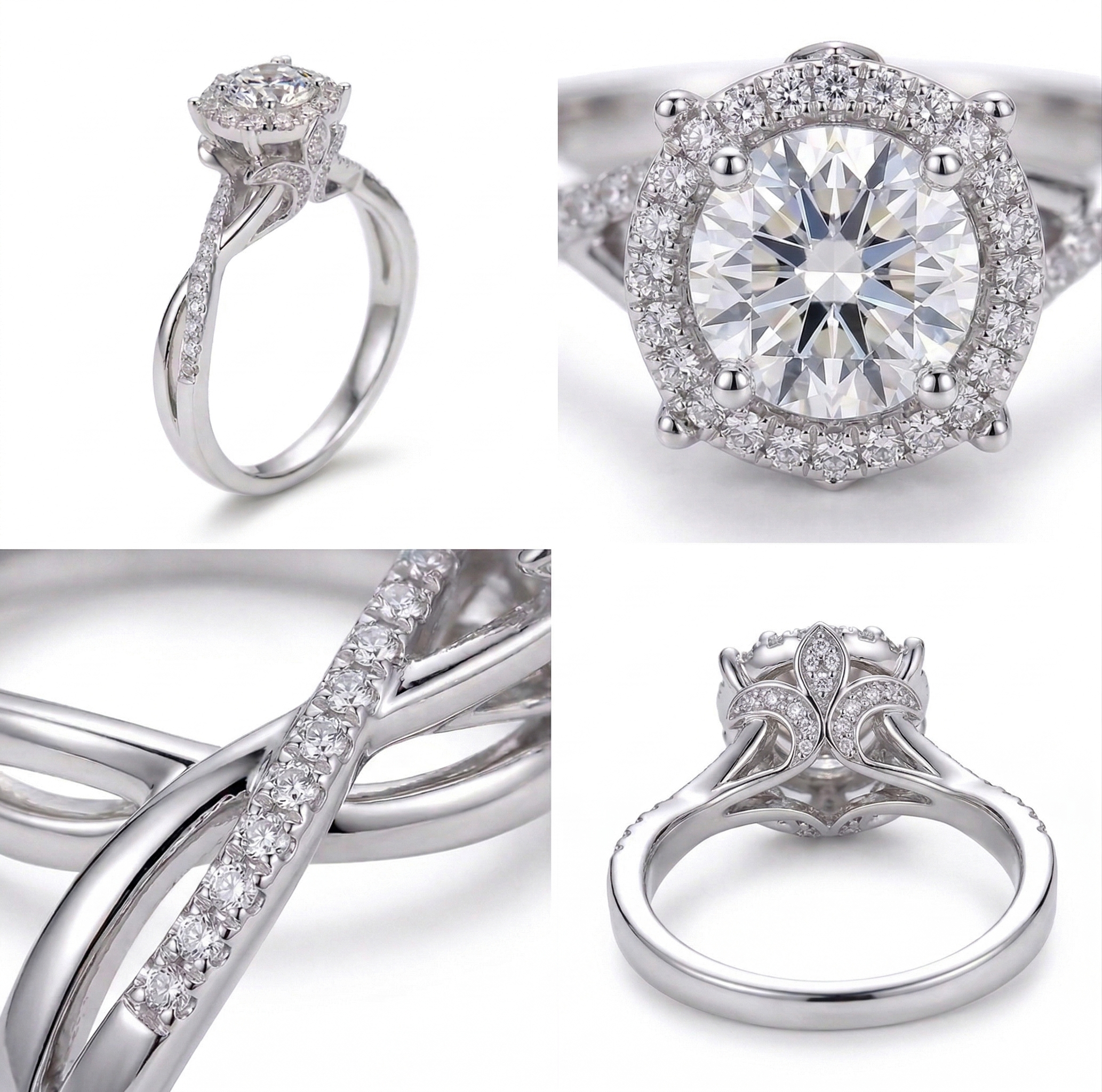
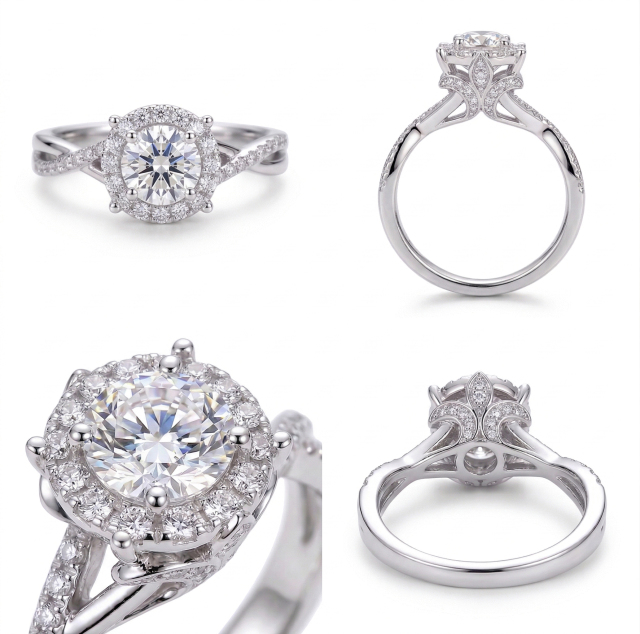
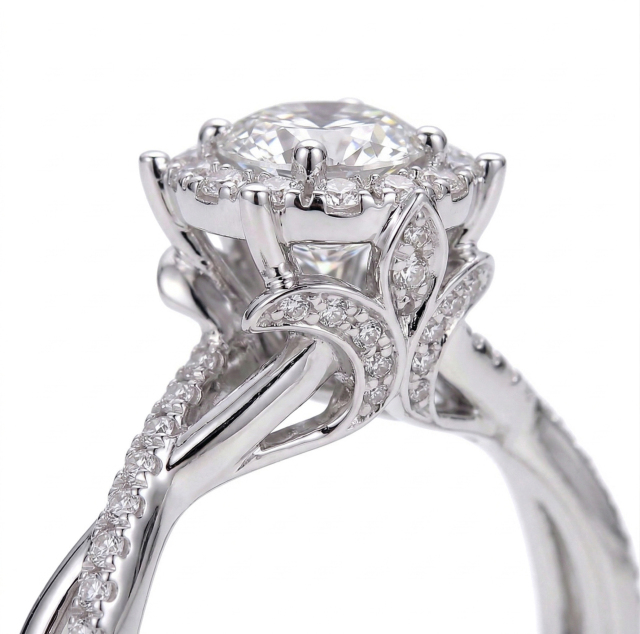
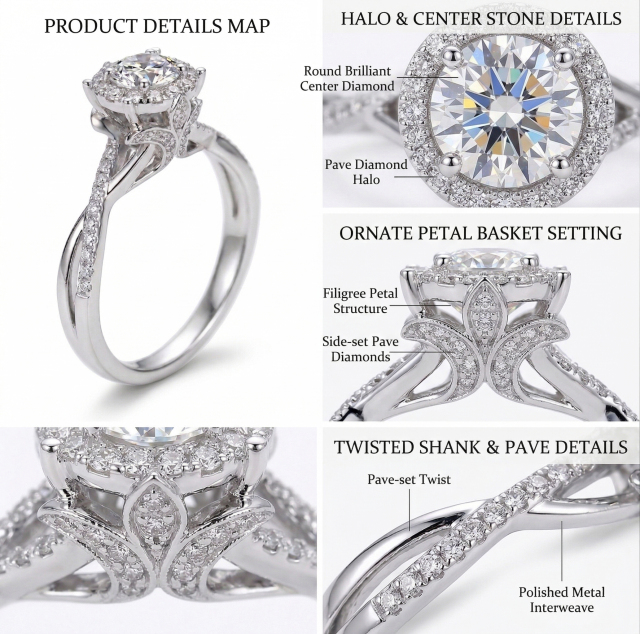
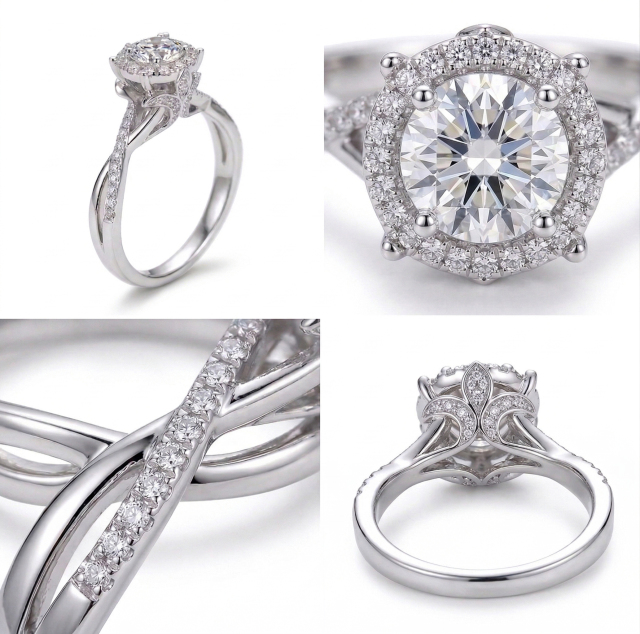
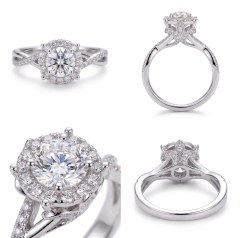
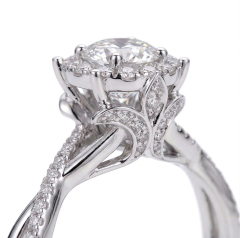
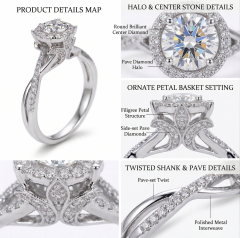
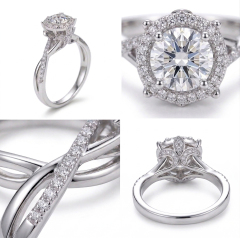
From the side, the centre stone sits in an openwork basket shaped like a ring of petals, with the gold cut away beneath the girdle so light passes under the stone instead of being trapped in a solid cup.
The filigree is structural as much as decorative: it holds the stone at four points and gives the gallery its height.
Those petals carry small pavé-set diamonds along their outer faces.
It is the detail people notice second — the ring still throws sparkle when it is seen edge-on, in a handshake or across a table, not only from directly above.
Halo proportion matters more than halo size.
On a D VVS2 lab diamond ring, a halo that runs too wide flattens the centre stone instead of lifting it, so the circle of pavé here is kept tight to the girdle and the centre stays the brightest element with a delicate footprint.
The band is a twisted shank halo ring in the literal sense: one strand of polished 18K gold crosses a pavé-set strand, so the two weave instead of sitting side by side.
It gives the piece movement from every angle and a Victorian flavour a plain band does not have.
The setting is finished by hand — prong tips rounded and polished so they do not catch on knitwear, the inside of the shank smoothed, the whole ring brought to a high lustre.
Filigree work like this is where a bench either has the patience or does not.
As-Grown HPHT Center Stone
As-grown is a statement about process, not a slogan: the stone came out of the growth chamber at D colour and nothing was done to it afterwards — no irradiation, no second heating run to bleach a tint out of the crystal.
That shows at the bench.
A lattice that has never been through a second treatment cycle stays clean under the loupe, the facet junctions stay sharp, and the stone reads as glassy and transparent rather than slightly muffled.
If you are comparing wholesale lab grown diamond rings from several suppliers, put the same two questions to each of them: which method grew the rough, and was the stone treated after growth.
The answers separate a documented stone from a described one.
We specify the growth method when the order is placed rather than discovering it when the parcel arrives.
That is the practical difference between a custom lab diamond engagement ring from a lab grown diamond ring manufacturer and one bought from a trading desk.
The point of an HPHT lab diamond engagement ring is that the whiteness is native — the D colour was graded on a stone that never had a colour correction applied to it afterwards.
Fixing the method at order level is also what keeps a reorder consistent with the first delivery: the same growth route, the same grade band, the same setting specification.
HPHT Versus CVD
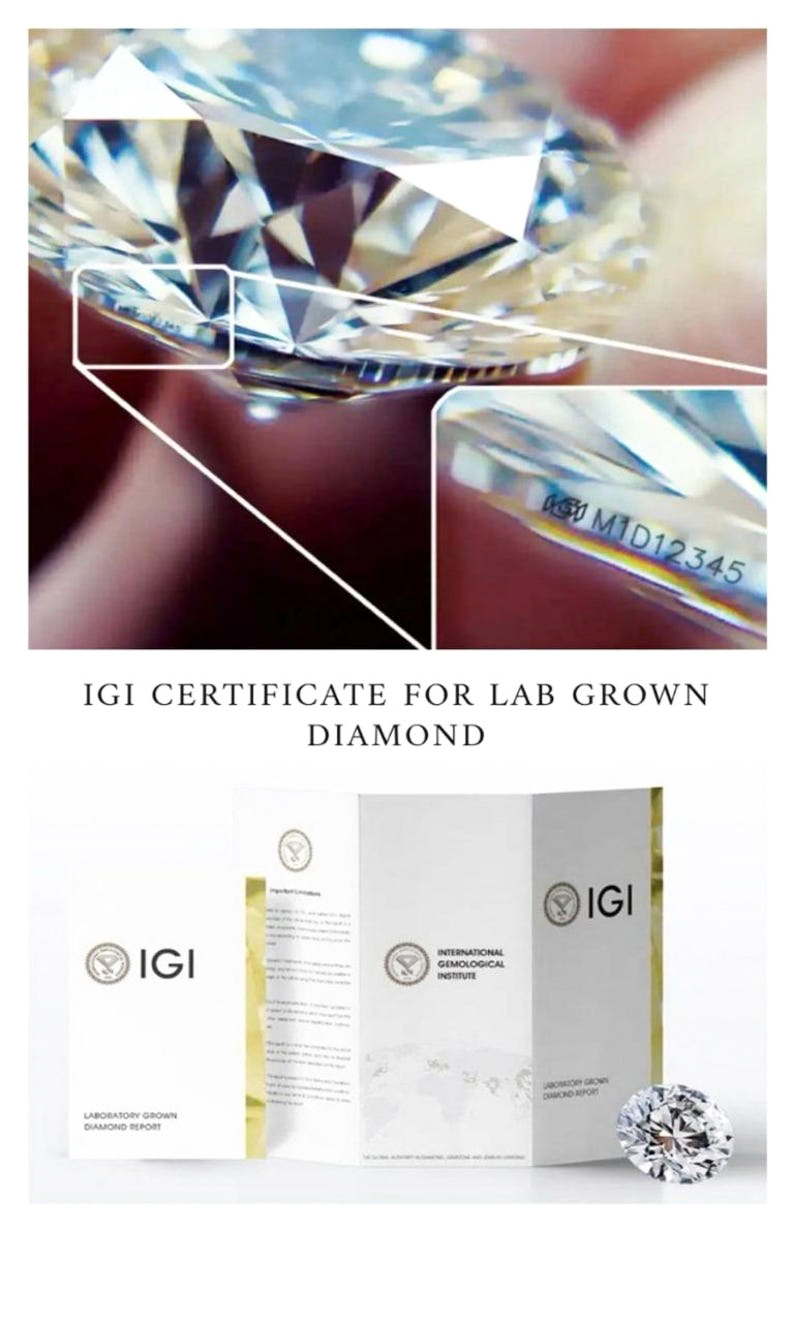
IGI operates a unified global calibration system, and its laboratories in Shanghai, Antwerp, New York, Mumbai, and Surat use the same master comparison stones and identical grading standards.
Claims that one regional IGI laboratory grades more leniently than another are misleading and often circulate through resellers who trade in wholesale lab grown diamond rings.
| Core comparison dimension | HPHT — used for this ring | CVD — common in the market |
| Mechanism and principle | Simulates the extreme conditions deep within the earth — 1.5 million PSI pressure and 1500 °C+ temperature — causing carbon atoms to crystallise | Breaks down methane gas in a low-pressure vacuum chamber using microwave plasma, depositing carbon atom by atom |
| Crystal growth structure | Forms a natural cuboctahedron, growing multi-dimensionally in 14 different directions | Forms a flat, layered structure, growing strictly in a single vertical direction |
| Rough stone colour purity | High-end HPHT equipment can naturally cultivate flawless D-E colour with no undesirable tints | Due to rapid growth, 80% to 90% of CVD rough stones develop undesirable brown, grey or pink tints |
| Need for post-growth treatment | Entirely unnecessary — as-grown, keeping its purest original crystalline state | Typically requires secondary extreme HPHT treatment to bleach the brown tints out |
| Negative risks of secondary treatment | None. The crystal lattice stays intact, giving supreme light transmission and a brilliant glassy lustre | Intense secondary heat can alter crystal lattice stress, often leaving a milky or hazy look that dulls fire and sparkle |
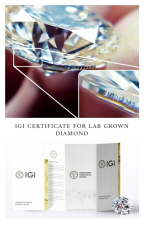
Reading the IGI Report
- Start with the grades.
- On a 0.6ct lab grown diamond ring the report states carat weight, colour, clarity and cut as measured values rather than adjectives, which is what lets a buyer put them straight onto a spec sheet.
- Read the origin line.
- The report identifies the stone as laboratory grown; that is the sentence an insurer or a future buyer reads first, and it is why the document belongs with the ring rather than in a drawer.
- Note what falls outside the paper.
- It grades the centre stone of this D VVS2 lab diamond ring; the setting, the metal and the pavé accents are not part of it, so an 18K gold lab diamond ring has to be judged on the metalwork in the photographs or on the bench.
- Disregard the regional rumour. IGI works to a single global calibration: the same master comparison stones, the same spectrometry equipment and the same gemologist training are used in Shanghai, Antwerp, New York and India. Posts claiming one laboratory grades more generously than another usually come from a reseller marketing a competitor's stock, and the small variations that do occur are ordinary grading tolerance rather than policy.
- File it with the piece.
- An HPHT lab diamond engagement ring sold with its report is easier to explain, easier to insure, and easier for your customer to hand on later — the paper is part of what you are delivering.
Customer Reviews
- Eleanor Davies, London, United Kingdom — I spent months looking for an ethical alternative to a mined diamond before I found this workshop.
- The 0.6 carat is right for my hand, elegant without shouting, and the twisted pavé shank with the petal basket makes it look like a Victorian heirloom.
- Isabella Rossi, Milan, Italy — I am an architect, so I notice structure.
- The filigree petals holding the centre stone are micro-engineering, and the side-set pavé means the ring sparks from every angle.
- My local gemologist checked the IGI Shanghai certificate and was struck by the VVS2 clarity and by the fact that no post-growth treatment was needed to reach that whiteness.
- Sophia Chen, Toronto, Canada — Ordering fine jewelry remotely made me nervous, but the design team answered everything.
- I asked for a small change to the 18K white gold twisted band and it was handled without fuss.
- The ring itself is blindingly brilliant, and wearing something conflict-free every day is a quiet pleasure.
- Amelia Thompson, Sydney, Australia — A D colour, VVS2, excellent cut stone in an intricate halo is hard to find at this level.
- Charlotte Müller, Munich, Germany — My fiancé surprised me with it.
- The interweaving band reads as two lives joining, and the IGI report is fully traceable through verifiable digital records.
- Knowing exactly how the diamond was grown, and that no colour treatment was applied, is what makes it special to me.
Specifications
Every stage of creation is completed under one quality control process by master artisans.
Because we are the source creator, bespoke customization is possible, such as switching to 18K rose gold, adjusting the center stone size, or adding a secret engraving inside the band.
Custom Work and Ordering
- Send the brief.
- Tell us what stays — the petal basket, the halo, the twisted shank — and what changes: metal colour, centre stone size or shape, or an engraving inside the band.
- A sketch, a reference photograph, a CAD file or a physical sample is enough to start.
- Review it on screen.
- Fix the size.
- Ask what resizing range the finished ring allows, what a resize costs, and how a size change is handled once a made-to-order piece has entered production — the answer depends on how far the bench has gone.
- Confirm what can move.
- Keeping the twisted shank halo ring as shown and changing only the metal is a straightforward edit; changing the basket or the stone shape depends on the design and may need a new setting.
- Any tooling or setting charge, and whether it is credited back once the design goes into volume production, is set out in the quotation.
- Confirm the order size.
- Whether a single piece can be supplied in this exact specification, the minimum for an 18K gold setting, and whether sizes or styles can be combined in one order are all confirmed with your sales contact before production.
- The same questions apply to wholesale lab grown diamond rings bought for a season.
- Agree the price basis.
- The ring is listed at $988.00 for a single piece; wholesale pricing is quoted against your stone, metal and size specification, and how the two relate is confirmed in the quotation rather than assumed from the listing.
- Agree the schedule and the paperwork.
- Sampling rounds, production time, packing and shipping are settled at quotation; the IGI report travels with the ring, and packaging can carry your own branding where you need it to.
Scale & Supply Capability
We have manufactured jewelry since 2008 — eighteen years as a source factory rather than a reseller.
Production, stone setting, polishing and packing all happen inside our own facility, so the team that quotes your order is the team that makes it.
We work in solid S925 sterling silver with rhodium and 18K gold finishes across the categories we supply, and we take on OEM and private-label work from your drawings, samples or reference pieces.
One coordinator follows your account from sampling through repeat shipments, keeping specifications and finishes consistent between orders.
FAQ
Are HPHT lab-grown diamonds real diamonds or simulants, and will anyone be able to tell the difference?
Real diamonds, not simulants.
An HPHT lab diamond engagement ring has the same crystallised carbon structure, the same 10 on the Mohs hardness scale and the same fire as a mined stone; only the origin differs.
Neither the naked eye nor a jeweller's loupe can separate them — identification takes laboratory equipment, which is exactly why the IGI report matters.
Anyone calling a lab-grown stone fake or a simulated diamond is describing cubic zirconia or moissanite, which are different materials altogether.
What makes the petal basket and twisted shank different from a standard four-prong setting?
A standard solitaire shows four claws and very little else once you turn it sideways.
On this twisted shank halo ring the gallery is a piece of jewelry in its own right — a filigree petal basket with pavé-set outer faces, so there is sparkle below the halo as well as around it.
In practice it reads as a vintage piece rather than a modern solitaire and it sits a little higher on the finger; if a wedding band will be worn alongside, ask us to shape the band to follow the basket so the two sit together.
Is a 0.6 carat stone big enough on the hand?
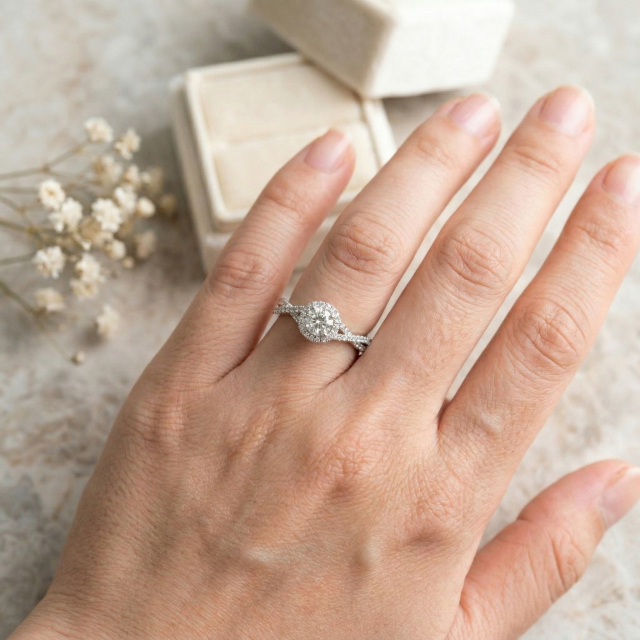
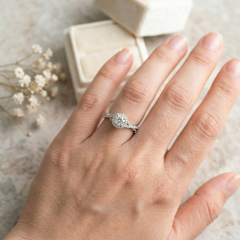
It is a wearable weight rather than a statement stone, which is why the setting does the work: the tight halo gives a 0.6ct lab grown diamond ring noticeably more presence than a bare solitaire of the same carat.
It suits a hand where a full carat feels heavy and it stays comfortable for daily wear.
If you want more spread, the same basket and shank can be built around a larger centre stone — that is a brief-stage decision, not a later one.
How can I check that the report belongs to my stone?
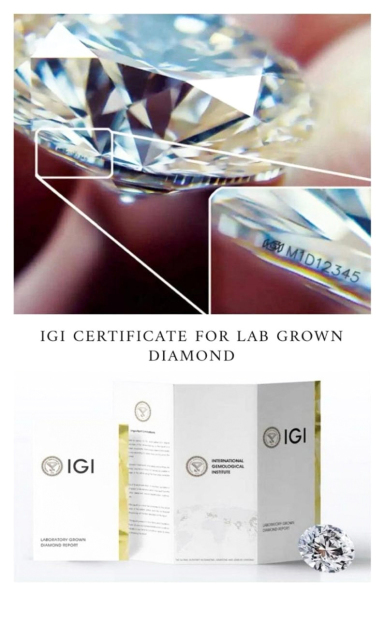
The report number is laser-inscribed on the girdle of the stone and matches the number printed on the IGI document.
That number can then be looked up in the IGI database and the carat, colour, clarity and cut compared line by line with the paper in front of you, and a local gemologist can confirm the inscription under a loupe in a few minutes.
Keeping the number with the ring is what makes the grades on a D VVS2 lab diamond ring checkable years later, including at resale.
Can I request bespoke changes to this design?
Yes.
As a lab grown diamond ring manufacturer we build from a brief rather than a catalogue — send a sketch, a reference photograph, a CAD file or an existing sample and we will confirm what can change and what should stay fixed.
The petal basket, the halo and the twisted shank are the identity of the design; metal colour, centre stone size and shape, and an engraving inside the band are the usual changes.
Every change is confirmed before anything is cut.
How should I clean and store the ring?
Warm water with a drop of mild washing-up liquid and a soft brush is enough for routine cleaning; rinse and dry with a lint-free cloth.
Keep an 18K gold lab diamond ring away from chlorine, perfume, hairspray and household cleaners, and store it in its own pouch or box so the pavé does not rub against other jewelry.
A yearly check of the prongs and pavé at a bench is the habit that matters most.
Will the pavé in the shank hold up to daily wear?
The pavé is set stone by stone into the metal rather than glued, and each piece is checked for flush seating before it ships.
On a custom lab diamond engagement ring the shank takes the most contact — car doors, gym equipment, the edge of a desk — so the honest advice is to treat it like fine jewelry rather than a plain everyday band and have the setting inspected once a year.
A loose stone caught early is a quick bench fix.